Preparing for the new workplace

The fact that robots are going to take over some jobs in the future economy is a given. There is no point in fighting it because change is here. How can workers adapt and succeed? According to Jeff Desjardins In Business insider, the following 10 skills are critical for success in the new economy:

  1. Complex Problem Solving
  2. Critical Thinking
  3. Creativitydownload (2)
  4. People Management
  5. Coordinating with Others
  6. Emotional Intelligence
  7. Judgment and decision making
  8. Service Orientation
  9. Negotiation
  10. Cognitive Flexibility

(Desjardins, June 2018)


When we compare the pros and cons of robots in the workplace it becomes more clear why there would be a shift in skills needed for workers who are working alongside robots. While robots may be more efficient in certain environments, they may not tire as quickly as humans, They may be more precise, be stronger and faster, however they can’t replace the cognitive and emotional parts of the human brain. For example a robot would not be able to interpret the opinions of their coworkers or customers. Robots would not be able to effectively manage and motivate workers to increase productivity. The workplace is still going to need higher level thinking skills that only humans can bring to the workplace.



New skills for a new workplace

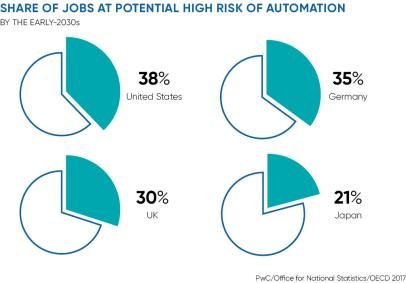
In my last blog I asked the question would robots in the workplace be good or bad for the workforce. There are many ways to look at this question depending on the approach you are taking. Aric Jenkins sites a report that suggests that robots could take up to 38% of jobs in U.S by 2030, impacting the transportation and storage, manufacturing and retail sectors(Jenkins, March 2017). CBC News recently reported that while the growing trend for artificial intelligence and robotics in the workplace could mean widespread job loss  these trends could be more positive than negative to the economy. Reporting for CBC News Ramona Pringle sites a World Economic Forum Report that says 58 million news jobs will be created(Pringle, 2018 October).

Job-losses-at-risk-from-automation-US
(Thiruchelvam, 2017)

While these statistics may appear very negative to workforce, there are a number of positives to this trend. Jenkins notes research that says productivity gains by the use of robots could have a positive effect on salaries(Jenkins, March 2017). The World Economic Forum Report that predicts the creation of 58 million new jobs also talks about the fact that 75 million will be displaced by automation this will mean that the workforce will need to adapt And worker will need to 

giphy3

develop new skills. In the short term this could be a negative as workers whose skill set are replaced by more efficient robots lose their jobs, many new jobs will be created and these jobs will require much higher education levels, creativity and problem solving skills. Workers who are able to adapt may find themselves working in more challenging and productive environments.


So what will this new workplace look like? What kinds of jobs will disappear and what new jobs will emerge? How will humans and robots work together?

The Future is Now

giphy2

I’ve always been interested in science fiction, and it is beginning to seem that more and more of what I read as a kid, is beginning to look a lot less like fiction, and a lot more like reality. As society becomes more reliant on technology, and as companies try to gain a competitive edge through workplace efficiencies, we look to technological solutions to solve workplace challenges.

This gets me to thinking about the use of robots in the workplace.  What can they do for business? What is the upside? What is the downside?  Will we need human employees at all?

In the article “Robots Used in the Workplace” Koening describes the genesis of robots in the workplace:

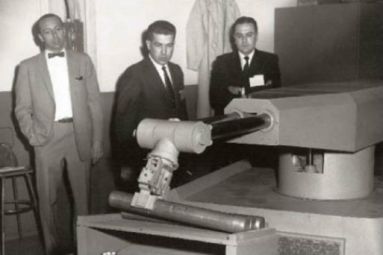
“The first robot in the workplace was created in 1956 by an engineer called Joseph F. Engelberger and an inventor and entrepreneur called George C. Devol. Known as the Unimate, the robot extracted die castings from machines and carried out spot welding on vehicles in General Motors. The success of the Unimate led to further development of robots for labor purposes. Companies started buying robots to see how they could incorporate the machines into in the workplace(Koening).”

joseph-f-engelberger-a-gauche-lors-de

It would seem that robots would be good for tasks that are very repetitive,  that require a high degree of accuracy and that would be dangerous to humans. Having robots perform these type of tasks could certainly be a benefit to companies. At the time that Koening published her article, she questioned whether robots might be able to drive vehicles one day. Now, just a short time later, self driving vehicles are already on the road.

With the speed of technological advancements, we can anticipate that robots in the workplace will only become more common as time goes on. This raises the question of whether this is a good thing or not. Will this have a detrimental effect on the global job market? Will this have a negative impact on humans in the workplace? Will the efficiencies that companies gain through this kind of automation be worth the human cost?

Please feel free to check my blog regularly to gauge my thoughts on this growing trend.